

6 ways the WHO misleads us on cell phone safety
Why does the media tell us cell phones are safe?

Here are six topics we’ll explore:
1. Cumulative call time
2. Real-life scenarios
3. Misinformation on power levels
4. Biased results
5. Heavy users of cell phones
6. Light users of cell phones
“What is wanted are blindness and intoxication and an eternal song over the waves in which reason has drowned.”
~ Friedrich Nietzsche
The word influenza gets its meaning as our ancestors ascribed flu outbreaks to the “influence” of the stars, aka electromagnetic impulses of cosmic energy. Scientists and doctors witnessed as rapid shifts in sunspots caused flu faster than transportation could carry any alleged contagion. Illness occurred at the quantum level of an instant.
The truly independent scientists of today recognize the same energetic influences in our surrounding cellular architecture, devices, and smart grid that is causing humanity to outbreak its shell of sanity. Social media influencers shout about the next pandemic while speaking no evil of the electronics making us sick.
As America now vows to become the AI capital of the world, techno-fanaticism pervades both left and right sides of the political spectrum. Head down we march into the quicksand of time lost to the void of endless distraction. How do we recover our future and break out of the past?
Nietzsche believed that if we gaze long enough into the abyss, the abyss may gaze back into us. Reclaiming our power can begin by averting where we place our attention by changing the medium, and media, of our mind.
While researching the latest stance of the World Health Organization on cell phones and cancer, I came upon a news broadcast on YouTube that wanted to reassure all of us that there’s nothing to worry about when it comes to cell phones harming us. All we need to do is trust the science.
Where does the doctor media personality in the above clip get his information? He cites a 2024 research review and meta-analysis (combines data from multiple independent studies) commissioned by the World Health Organization (WHO). The analysis was published1 by Ken Karipidis and colleagues and includes sixty-three studies between 1994 and 2022, stating cell phones “likely do not not cause brain cancer.” There are many flaws with this study, which include:
❌ Cumulative Call Time excluded
The study’s authors ignored the largest studies with statistically significantly odds (OR) in the highest exposed groups. Cumulative call time (CCT) is one of the most important variables to consider when studying the impacts on health effects. However, the 2024 WHO review only published users who had a low CCT, some as little as one minute per week for 10 years (2001-2011). Put into perspective, this is about 8.7 hours of total use in ten years.2 The study also did not publish the CCT results of high users, and excluded the data on the graphs included in the study. Dr. Joel Moskowitz and colleagues countered the WHO review with their own study. Their comprehensive analysis of studies found significant evidence linking cellular phone use to increased tumor risk, especially among cell phone users with cumulative cell phone use of 1000 or more hours in their lifetime (which corresponds to about 17 min per day over 10 years).
❌ Real-life scenarios excluded
The Karipidis study did not take into account laterality, or the side of the head used during mobile phone calls related to the location of brain tumors. Studies on laterality show clear evidence of increased risks of brain tumors for ipsilateral (same side as the brain tumor) use of the mobile phone, including also the cordless phone. Thus, results on the most exposed part of the brain were excluded.
The WHO review by Karipidis also only included five studies that modeled (simulated) exposure from transmitters or base stations and only studies on pediatric cancer, thereby excluding several studies showing increased risks for cancer in children and adults near transmitters and base stations. One of the two included base station studies reported increased risk “of all neoplasms in children with higher-than-median RF exposure to [Mobile phone base stations] MPBS”. Yet, the authors claimed there would be “moderate certainty evidence” of no childhood leukemia risk.
All use of cordless (DECT) phones was disregarded although they were also exposed to the same kind of RF radiation as from mobile phone use. Lennart Hardell and colleagues has shown that also use of cordless phones is associated with increased risk for glioma and acoustic neuroma tumors.3
Powerful misdirection
Karipidis and colleagues state in their review that the “average output power of a cordless phone is 1–2 order of magnitude less than that from 1G to 2G mobile phones,” and also write that “most participants in the reviewed studies had used mobile phones operating on 1G-2G networks, and mobile phones of newer technology (3G-4G) have substantially lower average output power.” Here the authors are referring to the SAR (specific absorption rate), or the amount of radiofrequency energy absorbed by the body. The SAR measurement is misleading as it does not take into account the frequency or the electric fields generated by cellular base stations or mobile phones. While you may have a microwave that is less powerful, which may not heat your food as quickly, the frequency of 2.45 GHz is still the same, and has biological effects on DNA.4
Older cell phones used lower frequencies, whereas newer cell phones use higher frequencies. As frequency increases, the wavelength (or space between each electromagnetic pulse) is lessened, resulting in more information transmitted over a shorter distance. The inverse is also true - lower frequencies have longer wavelengths, which means that they can travel further and more easily penetrate walls and objects. Newer 5G cellular system use laser beamforming (shorter wavelength) technology, which has a substantial increase in power level and power density from older (1G-4G) generations.
Support our work with a premium subscription.
(just $5 per month)
❌ Biased results
Several of the authors in the Karipidis group have conflicts of interest, with ties to ICNIRP, a private organization that has recommended the exposure limits that most countries in the world have adopted. The telecommunications industry has adapted their technology to the ICNIRP limits. Several investigations5 have concluded that there are ties between the telecommunications industry, the ICNIRP and the WHO6, the latter commissioning the Karipidis report. According to the Ethical Council at the Karolinska Institute, Stockholm, Sweden in a verdict on Anders Ahlbom at Karolinska Institute Stockholm, the membership in ICNIRP is a potential conflict of interest.7
Here’s an example of the revolving door between lobbyists and the FCC, which overseas safety limits on wireless radiation:
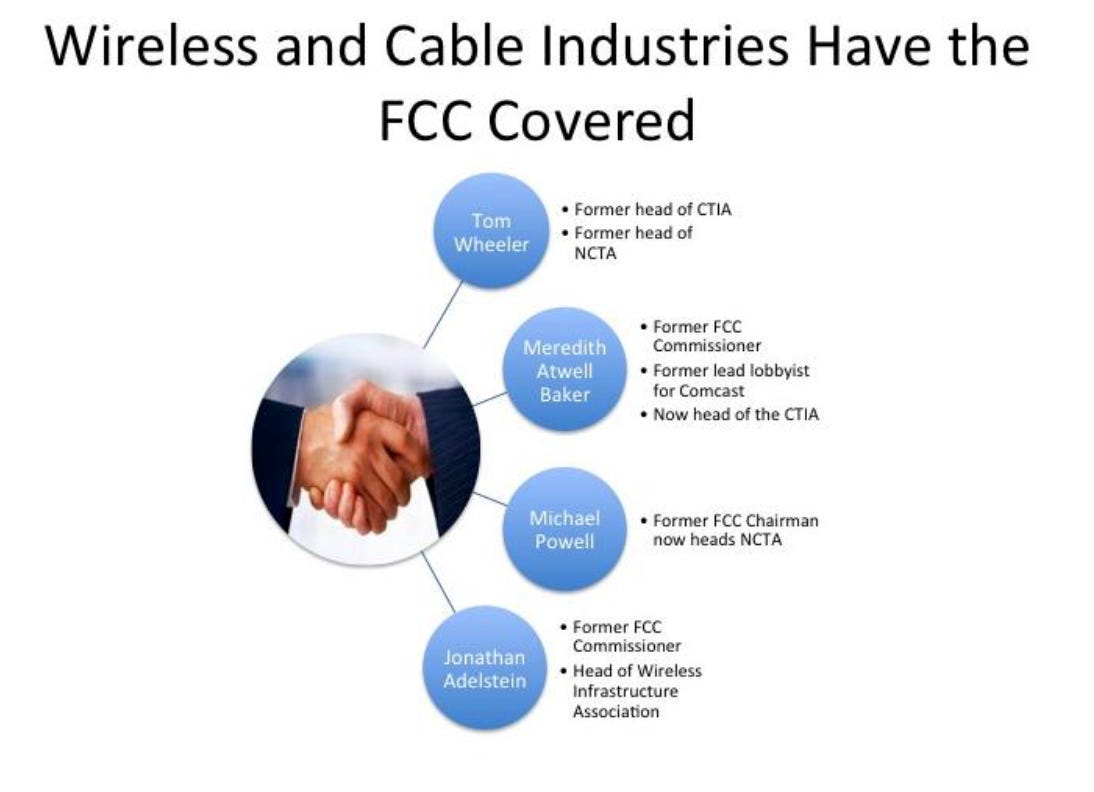
According to one of the major telecomm infrastructure providers, lower limits than ICNIRP’s would make the 5G roll out “difficult or impossible.”
Below is a list of authors with conflicts of interest:
Ken Karipidis, first author, is member of ICNIRP (today vice chair), since 2015
Dan Baaken, second author, is scientific secretary of ICNIRP since July 2024.
Tom Loney has performed research and provided advisory services to the defense, industrial and healthcare sectors. The defense industry has interests in the outcome of a cancer risk evaluation of RF radiation, thus a potential conflict of interest.
Martin Röösli is a member of ICNIRP since 2016. In addition, he has received funding for research from a Swiss foundation funded by the telecommunications industry8 that serves as an intermediate between telecom industry and researchers.
Susanna Lagorio has collaborated with scientists with known conflicts of interest in terms of funding from industry and membership in ICNIRP.9 She has testified on behalf of Radio Vatican regarding cancer risks from the RF-radiation.
❌ Heavy cell phone users excluded
According to the highly-touted Interphone study10 conducted in 2010 by the World Health Organization, the results on cell phones and brain cancer are inconclusive. The study included 2,708 cases of glioma and 2,409 of meningioma, another type of brain tumor, with a total of over 5,634 controls —from 13 countries. It is the largest study of cell phone and tumors ever done. The total budget of the study, which got underway in 2000, was €19.2 million (~US$25 million). Funding came from the European Commission (€3.74 million) and the cell phone industry (€5.5 million), as well as other sources.
I read the study, and do you know what I found?
The published paper did not include heavy users of cell phones.
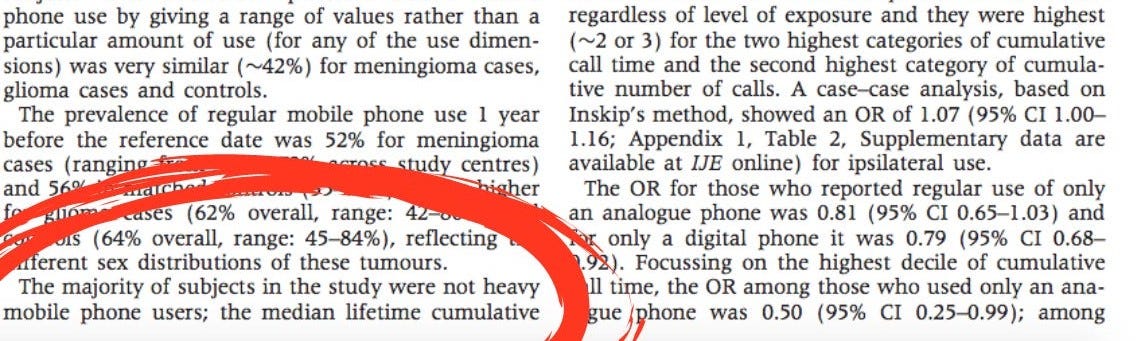
“That’s like doing a study on obesity looking at people that are slightly overweight.”
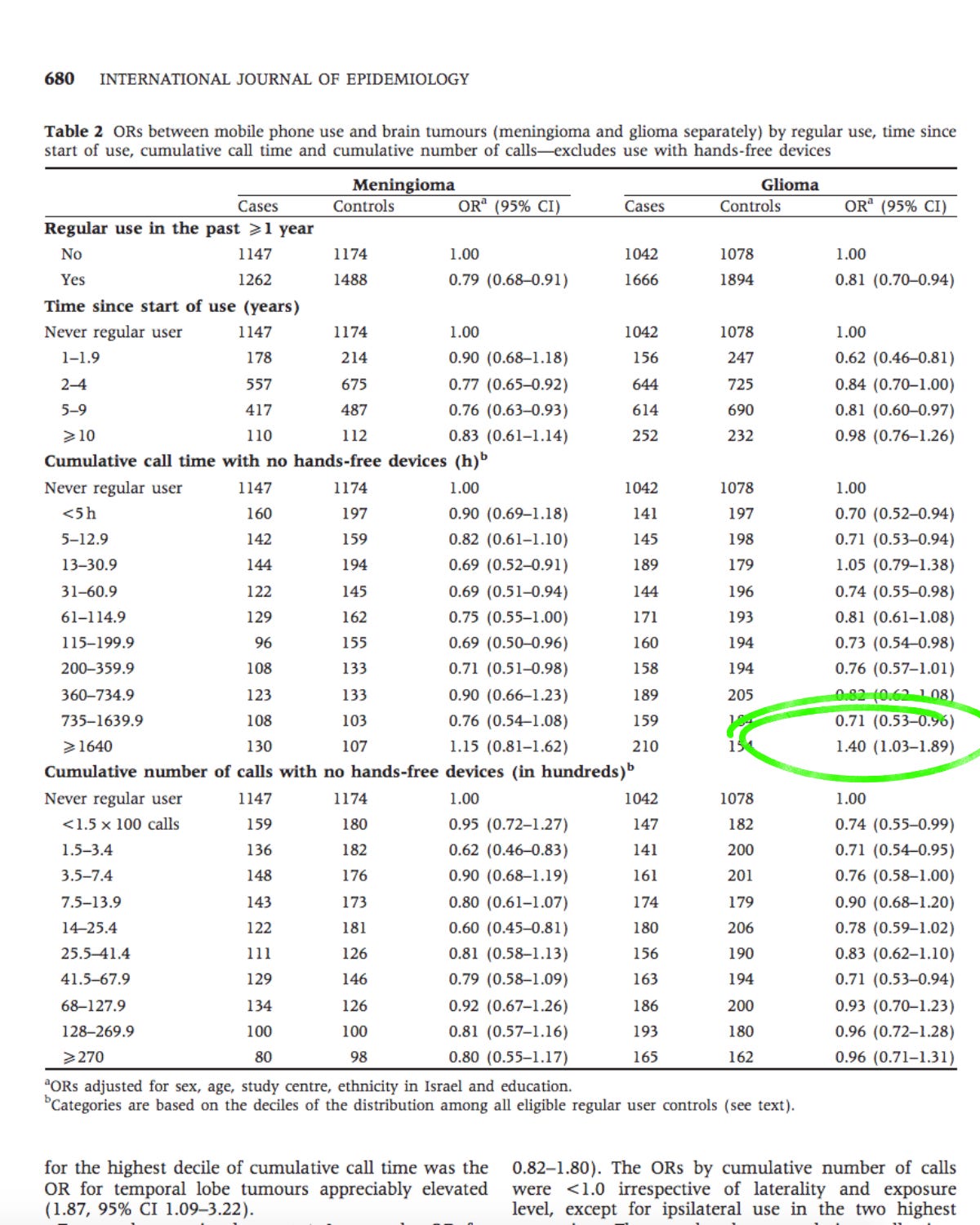
The parts of the study that did look at high cell phone users found a doubling and up to a quadrupling of tumors. The chances (odds ratio, OR) of having brain cancer doubled once you were a heavy cell phone user:
❌ Light users also excluded
Jack Siemiatycki of the University of Montreal, a member of the Canadian Interphone group, called the study “genuinely perplexing, enigmatic and paradoxical” because, as he put it, "the data were dirty.”
The way the data were collected created what is known in research as selection bias, which occurs when certain individuals or groups are more likely to be included or excluded, leading to inaccurate or misleading conclusions. Interphone is a case-control study, in which those with brain tumors are compared with a reference group. In the published paper, the members of the reference group are those who never used mobile phones. In the appendix, which is only available when doing an internet search, and not attached to the main study, has a recalculation that includes the lightest users of cell phones (i.e. those who used cell phones for less than two years) The reason for the substitution is that the non-users were not properly matched to the users, which distorted the results.
When the Interphone team analyzed the data in a way to compensate for selection bias, they saw a much more provocative picture of the risks associated with long-term use of cell phones. Those who used a mobile phone for ten or more years were found to be twice as likely to develop a brain tumor. This increased risk is statistically significant. Indeed, the risk is higher for all three indices of exposure —years of use, total talk time and total number of calls. There even appears to be a dose-response relationship, with the highest risk among the heaviest users.
~ Source: Microwave News
In a series of interviews with Microwave News, members of the Interphone project said they now see the risk among long-term users as being larger than when the study began. Some think the risk warrants serious attention:
“To me, there’s certainly smoke there…overall, my opinion is that the results show a real effect.” Elisabeth Cardis leader of The Interphone project
Ms. Cardis is with the Center for Research in Environmental Epidemiology (CREAL) in Barcelona,11 and also worked at IARC (International Agency for Research on Cancer) for close to a decade.
As reported by Microwave News:
Siegal Sadetzki,12 the Israeli member of Interphone, goes further. She pointed out that while the risks are inconclusive, a number of the results show some consistency. These include increased risks among the heaviest users, the fact that the risks were highest on the side of the head the phone was usually used and that the tumors were in the temporal lobe of the brain, which is closest to the ear.
Where do we go from here?
Where there is smoke there’s usually fire. The problem is we’ve been living in a collective brain fog of war so long that we’ve been unable to see the smoke through the haze that has become our invisible maze of radiation. The only way out is through. Our war is won with drills of peace each day, marching off to nature’s front line, bombing distractions in airplane mode, and calling our family and friends for reinforcements.
“We’re not just facing a technological revolution. We’re in the midst of a full-blown spiritual war that’s largely invisible and occult in nature.
I call it the ‘end game’ because the outcome determines the spiritual future of humanity.”
~ Bernhard Guenther, Time of Transition: The Battle for the Soul
In today’s technological war, let us take up arms by surrendering the weapons of our foe to the arsenal of the hazardous waste bin.

👉 If your life has been positively impacted by our work, would you please leave us an online review here?
Additional Resources:
DONATE to our Upcoming Children’s Book (Yes…still in the works) on EMF:
Check out The Power Couple Bookshop - dedicated to helping us relearn from our ancestors!

Support us the old fashioned way!
Send us an email to info@thepowercouple.ca if you’d like to send us other forms of payment, including 🐌 mail.
Ken Karipidis, Dan Baaken, Tom Loney, Maria Blettner, Chris Brzozek, Mark Elwood, Clement Narh, Nicola Orsini, Martin Röösli, Marilia Silva Paulo, Susanna Lagorio, The effect of exposure to radiofrequency fields on cancer risk in the general and working population: A systematic review of human observational studies – Part I: Most researched outcomes, Environment International, Volume 191,2024,108983,ISSN 0160-4120, https://doi.org/10.1016/j.envint.2024.108983.
Lennart Hardell, Mona Nilsson. A Critical Analysis of the World Health Organization (WHO) Systematic Review 2024 on Radiofrequency
Radiation Exposure and Cancer Risks. Journal of Cancer Science and Clinical Therapeutics. 9 (2025): 09-26
Hardell L, Carlberg M. Mobile phones, cordless phones and the risk for brain tumours. Int J Oncol. 2009 Jul;35(1):5-17. doi: 10.3892/ijo_00000307. PMID: 19513546.
Effects of radiofrequency electromagnetic waves (RF-EMW) from cellular phones on human ejaculated semen: an in vitro pilot study. Fertil Steril. 92(4) 1318-1325, 2009.
Buchner K, Rivasi M. The International Commission on Non-Ionizing Radiation Protection: Conflicts of interest, corporate interests and the push for 5G Brussels June (2020)
https://romanshapoval.substack.com/i/99270587/the-revolving-door-keeps-spinning
Ethical Council, Karolinska Institute, Stockholm. Sweden DNR 3753-2008-609 (2008).
https://www.emf.ethz.ch/en/
https://microwavenews.com/news-center/repacholi-half-who-emf-project-funding-came-industry
The INTERPHONE Study Group, Brain tumour risk in relation to mobile telephone use: results of the INTERPHONE international case–control study, International Journal of Epidemiology, Volume 39, Issue 3, June 2010, Pages 675–694, https://doi.org/10.1093/ije/dyq079
http://www.creal.cat/creal/quisom/en_info_user.html?idusuari=ecardis
http://www.gertnerinst.org.il/e/epidemiology_e/cancer_e/Cancer_director_e/
Simple answer: you lived fine before phones, just shut it off and put it in a faraday cage and use it very sparingly, or just ditch it.
Thanks, Roman and Bohdanna. Using this for today's Lockdown Times!