


Here’s what we’ll learn in this article:
1. How did the dawn of radio affect bees?
2. Why does RF starve bees of oxygen?
3. How do our mitochondria use light to create energy?
4. How do cell phones create colony collapse?
5. How do bees use magnetic fields to navigate?
6. How do bees use electric fields to fly?
7. Why are pesticides a red herring?
8. What DNA mutations may EMF cause in insects?
9. Pollination decline and crop failures observed in Greece
10. Why shungite protects beehives
11. JOIN World Cancel Your Cell Phone Plan Day
“Work that you may keep pace with the earth and the soul of the earth.
For to be idle is to become a stranger unto the seasons, and to step out of life’s procession, that marches in majesty and proud submission towards the infinite.”
~ Kahlil Gibran
An ancient sun rises over horizons long-forsaken, drizzling a distant turquoise sea with its amber nectar of light. The morning sounds its alarm with a serene hum, abuzz with the vehicles of Life’s workers sent rushing along the muffled meadow highways of an Earth waiting to be born again. As we embark into the merciless light of day to render fields bountiful with our toil, we quickly find ourselves placated by the melodies of bird and beast, as they watch and wait for us to work in unison. Like the busy bee, life’s work of love all can see.
Through our sorrow we come to know the joy of tomorrow if we surrender our ambitions to the resolve of nature - where nothing is rushed, yet all is accomplished. Today the lust for control has propelled mankind past Elysian fields of courageous peace, and over the precipice like a bison caught in the bush fires of progress. Technocratic plantation owners disguised as good shepherds of science impatiently wield the pendulum of progress like a scythe, threshing our future into dust.
The first colony collapses
In 1898 the young Italian inventor, Guglielmo Marconi came to the Isle of Wight, off the southern coast of England, to build the world’s first permanent wireless station. In 1901, as Marconi sent the world’s first long-distance radio transmission from this island, the honey bees began to vanish. By 1906, the island, then host to the greatest density of radio transmissions in the world, was almost empty of bees. Thousands of bees, unable to fly, were found crawling and dying on the ground outside their hives. “They are often to be seen crawling up grass stems, or up the supports of the hive, where they remain until they fall back to the earth from sheer weakness, and soon afterwards die,” wrote Augustus Imms of Christ’s College, Cambridge in 1906. Ninety percent of the bees had already vanished from the entire island. Unable to find a cause, Imms called it Isle of Wight disease.
Swarms of healthy bees imported from the mainland began dying off within a week of arrival. In the following decades, Isle of Wight disease spread along with radio broadcasting to the rest of Great Britain, Italy, France, Switzerland, Germany, Brazil, Australia, Canada, South Africa, and the United States. In the 1960s and 1970s its name changed to “disappearing disease.” It became urgent in 1996, when cell towers began to be erected throughout the United States, and became a worldwide emergency by 2006, when it was renamed “colony collapse disorder.” In the winter of 1995-1996, beekeepers lost 45 percent of their hives in Kentucky, 60 percent in Michigan, and 80 percent in Maine. By 1997, 90 percent of all feral honey bee colonies had disappeared nationwide. Today not only domestic bees, but also all wild bees are in danger of extinction.1 More than a century later, the description of this mystery disease is exactly the same.
[Source] Cellular Phone Task Force:
“On November 19, 2019, a 5G antenna was placed 250 meters from Angela’s house in Melbourne, Australia. ‘I photographed the new mast going onto the cell tower,’ she writes, ‘and the next day, I was in the driveway talking to our carpenter, and we saw bees dropping on the driveway then dying. I managed to film one trying to collect pollen, but it was hanging upside down and could not seem to make it to the centre of the flower, then it rolled off the petals to the ground.
Europe’s first UMTS network—what is now known as “3G” technology, which greatly expanded the network of cell towers and connected them all to the Internet, enabling the operation of smartphones—went into service in the fall of 2002, just before the disastrous winter during which so many of Europe’s honey bees vanished.
Ferdinand Ruzicka, a medical physicist and beekeeper in Austria, wrote an article in Bienenwelt (“Bee World”) about this problem in 2003 and published a survey form in Bienenvater (“Beekeeper”) requesting to be contacted by beekeepers with antennas near their hives. Ruzicka’s colonies had collapsed after telecommunications antennas appeared in a field near his hives. The majority of Bienenvater readers who filled out his form similarly observed that their bees had become suddenly aggressive when antennas appeared, had begun to swarm, and that their healthy colonies had vanished for no other reason.
During the winter of 2006-2007, when disappearing disease was renamed “colony collapse disorder,” a team of researchers examined thirteen large apiaries owned by eleven different commercial beekeepers in Florida and California, and could not find any specific nutritional, toxic, or infectious factor that differentiated bees or colonies with and without colony collapse disorder.
The supposedly devastating Varroa mite was not more prevalent in collapsed or collapsing colonies. in collapsed or collapsing colonies. The only specific observation they were able to make was that colony collapse disorder was location-specific, and that colonies with this disorder tended to cluster together. The colonies in those locations not only died, but tended to be left alone even by the parasites that normally infest dead honey bee colonies.
The Fish & Wildlife Service reports that the American bumble bee, formerly the most common species of bumble bee in the United States, has disappeared entirely from 12 states and is in severe decline in the 35 states in which it is still found. The petition from the Center for Biological Diversity reports that this species exists at only 11% of its former abundance, and that its rapid decline began only 20 years ago, in 2002.2 Until the mid-1990s, the western bumble bee was abundant in forests, fields, and urban backyards throughout western North America, from New Mexico to Saskatchewan to Alaska. It has now vanished except for small pockets in the Colorado Rockies. The rusty-patched bumble bee has not been seen in New York State since 2004. The Franklin bumble bee, formerly prevalent in southwestern Oregon, has not been seen since about 2005.
A buzzing metabolism
For aeons, life evolved in an electromagnetic field that nourishes the Earth, and streams down from the stars. During calamitous points within the celestial cycle of time, life suffered greatly while attempting to adapt to the acute onslaught of cosmic rays. Like plants meticulously pruned for God’s garden, life was hardened off to withstand natural radiation. In contrast, the creatures and living beings of this world have never evolved in the synthetic electric and radiofrequency radiation that has enveloped the Earth for over a century. Picture a stack of four hundred coins, which symbolizes our human history of the past 100,000 years. The 400th coin represents everything that’s happened since the American Revolution.
This radiation affects biology in many ways, but most critical for bees is its interference with their metabolism. Radiofrequency affects the electron transport chain of the mitochondria, which is where the last, energy-producing step in metabolism takes place. Within this chain is where electrons generated by the sugars, fats and proteins we eat are transferred to the oxygen we breathe, resulting in the generation of ATP (adenosine triphosphate). Metabolic disruption affects bees more than other creatures because bees have such a high metabolic rate of electron transport in the mitochondria of cells. In short, radiofrequency deprives bees of energy by starving them of oxygen.
This phenomenon was proven in 2011 in a study entitled “Exposure to Cell Phone Radiations Produces Biochemical Changes in Worker Honey Bees.” These researchers exposed bees to an ordinary cell phone and sampled their hemolymph, a substance which transports nutrients to cells and tissues. After 10 minutes of exposure to a cell phone, the concentration of total carbohydrates in their hemolymph increased from 1.29 to 1.5 mg/ml. After 20 minutes it increased to 1.73 mg/ml. In other words, after just ten minutes of exposure to a cell phone, metabolism of sugars, fats and proteins was severely inhibited. If bees cannot metabolize their food they cannot fly. They will crawl on the ground and die.
For the geeks:
While in a cold shower after an intense workout the other night, I thought about the relationship between cold, light, oxygen, and heat. Cold exposure is the cool blue spark of our mitochondrial furnace, and the cold forces our cells to emit UV. As our mitochondria become energized they use UV light to deliver large amounts of direct electric current to oxygen.3 Recent research4 has discovered that our mitochondria are a literal oven, able to maintain a temperature that is 15° C (59° F) higher than our external environment! A clean light environment allows us to shovel more coal into our furnace. When surrounded by electrosmog that clouds the wavelengths of light only bees can see, Mother Nature can’t fuel her fire.
Colonies keep collapsing
The quickest way to destroy a bee hive is to put a wireless phone inside or beside it. In 2009, VP Sharma and Kumar5 placed two cell phones each — one in talk mode and one in listening mode in order to maintain the connection — in two of four hives. They turned them on at 11:00 in the morning for 15 minutes, and again at 3:00 in the afternoon for 15 minutes. They did this twice a week between February and April. As soon as the phones were turned on the bees would become quiet and still. During the course of three months fewer and fewer bees flew in and out of those two hives. The number of eggs laid by the queen declined from 546 to 145 per day. The area under brood declined from 2,866 to 760 square centimeters. Honey stores declined from 3,200 to 400 square centimeters. “At the end of the experiment there was neither honey, nor pollen nor brood nor bees in the colony resulting in complete loss of the colony,” wrote the authors.6
Sainudeen Pattazhy, a professor at Sree Narayana College, placed one cell phone inside each of six bee hives and turned the phone on for just ten minutes, once a day for ten days. While the phone was on, the bees became still. The egg-laying rate of the queen declined from 355 to 100 per day. After ten days no bees were left in any of the hives.
[Source] Cellular Phone Task Force by Arthur Firstenberg:
“A 2011 study7 from Switzerland by Daniel Favre also demonstrates the effects of cell phones on honeybees. More than 80 sound recordings were taken from 5 different hives during February through June 2009. A cell phone was placed in the hives near the bees. When the cell phone was off, or on standby mode, the bees were not disturbed. When the cell phone was turned on, the effect was dramatic: within 25 to 40 minutes the sounds made by the bees increased in intensity and frequency, producing the “worker piping signal.” If the cell phone was turned off immediately, the bees calmed down within 2 or 3 minutes. If the cell phone was left on for 20 hours and then turned off, the piping signal continued for up to 12 hours more. The effect was consistent and repeatable. Worker piping usually indicates bees are preparing to leave the hive in a swarm.
Favre refers to another study done in India, where a mobile phone was kept continuously on near a beehive it resulted in collapse of the colony in 5 to 10 days, with the worker bees failing to return home. Starting in 2003–2004, bee colonies worldwide suddenly began to show symptoms of the so-called colony collapse disorder (CCD). This condition initially affects the worker bees, which desert the hive. The queen bee is usually abandoned in the hive with the young brood and with an abundance of honey, so that the colony can survive for a very short time. However, without the worker bee population, the colony becomes unsustainable and dies out. Never before have honeybees disappeared globally and at such a high rate.”
Magnetic navigation: Earth’s GPS
All life depends on natural electric and magnetic fields for orientation and navigation through Earth’s atmosphere. Wireless technology introduces artificial fields that constantly change, and are much more powerful than the native electromagnetic spectrum. As a result animals become confused and fail to navigate back to their home environment. German biologist Ulrich Warnke author of Bees, Birds and Mankind: Destroying Nature by ‘Electrosmog’, reviews the science on the effects of electrosmog on orientation, navigation and communication in birds and in bees.
All insects possess cryptochromes in their eyes and brain, which function as magnetosensors under blue light (red light in the case of birds). Insects that are active in the dark seem to use a magnetite-based magnetic sense instead; this has been experimentally confirmed in bees, ants and termites. Warnke cites other experiments, which proved that an accumulation of bio-magnetite particles serve as receptors of the magnetic field. These iron granules are arranged in a band in the abdomen of the bee.
Honeybees respond to very small changes in the constant local geomagnetic field intensity.8 The maximum sensitivity of the bee to earth’s magnetic variations is around 26 nT (nanoTesla). The average TV generates a magnetic field that is 500 times more powerful at 1300 nT. Significantly amplifying the magnetic field compared to the normal biological range can cause a massive disruption in insect communication. Warnke found that if the field is amplified to 10 times that of the earth’s magnetic field, the colony swarms, away from its hive.
Electrical highways
When the ancient Greeks rubbed amber, they discovered frictional electricity. This discovery is one of man’s oldest observations and has lent its name to the entire electrical discipline (electron: Greek for amber). When two surfaces make contact on the molecular level, positive and negative charges are separated at the point of contact through charge transfer. Many such points are activated in a short space of time by friction. Animals can become statically highly charged through friction between air molecules and body tissue, especially in flight. To increase electrical and magnetic field strengths, animals have various aids such as protruding spikes on their wings.
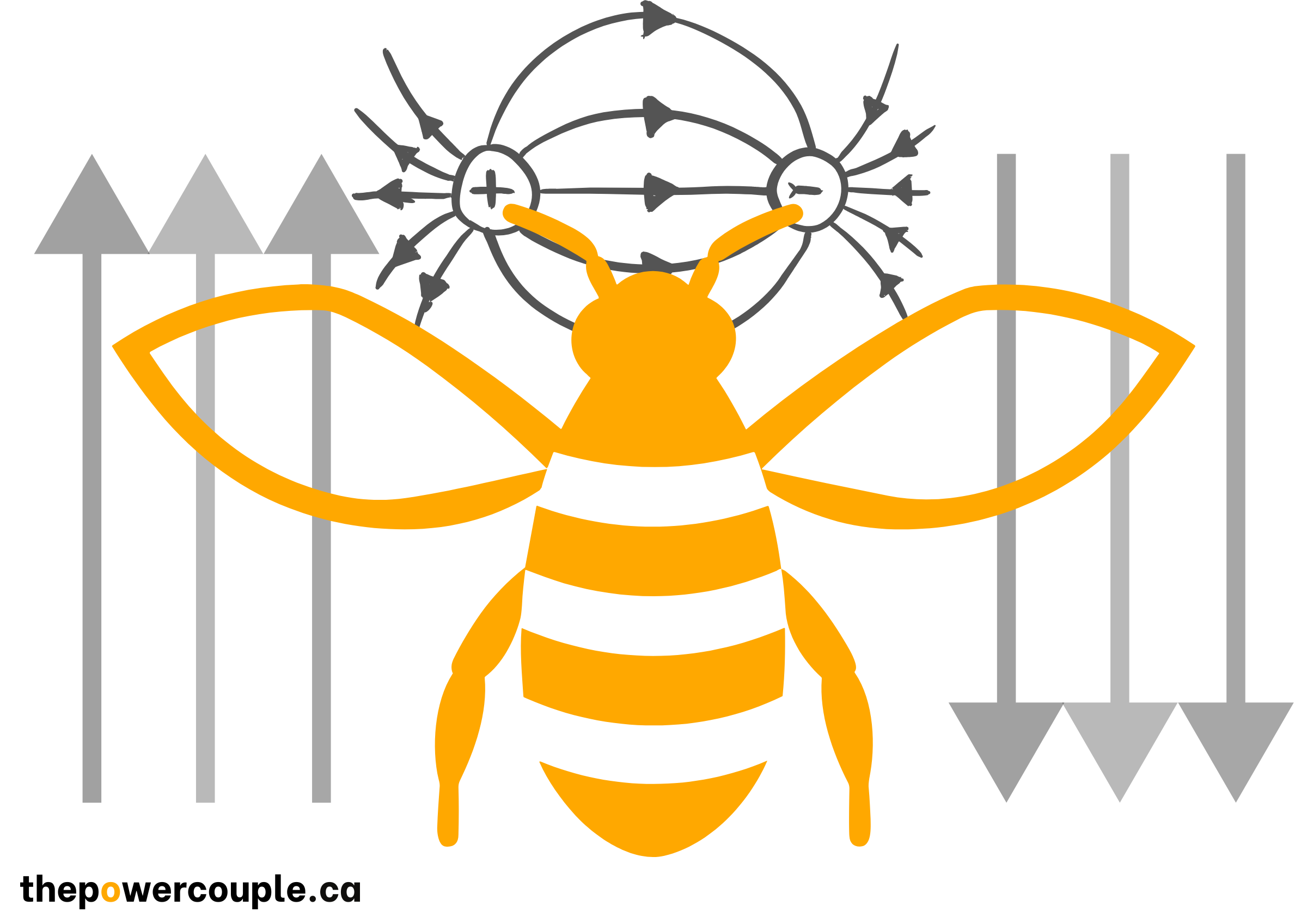
Crowding the bees’ ancient superhighways with the traffic of electric current is a blindspot many environmentalists don’t see because they’re too busy whipping down main streets of data, ignoring the road signs of independent scientists.
Support our work!
Unlock all the benefits of becoming a paid subscriber.
(just $5 per month)
The Pesticide Myth
In October 2012, Harvard researchers setup 18 hives at three locations in Massachusetts. At each location, four hives were fed high fructose corn syrup laced with neonicotinoids (insecticides that act as nerve poisons), and two were left untouched. By the spring of 2013, researchers said half of the colonies treated with pesticides had abandoned their hives — the key symptom of CCD. The ones that were left weren't in good shape. Their honeybee clusters were very small and either lacked queen bees or developing bees, the study said.
There are a few issues with this study. While neonicotinoids are harmful to bees, they do not explain the entire picture behind colony collapse. Even though many bees may be exposed to pesticides, they typically do not feed on corn in the wild or are directly fed high fructose corn syrup. In 2017, a major German study9 found that flying insects had decreased over 75% in protected areas over the previous 27 years while ruling out climate change and pesticides.
The Harvard study also cannot explain why people in other areas without pesticide use are seeing a rapid increase in colony collapse. Diana Kordas is a naturalist living on the island of Samos, Greece. She has been recording her observations about animal and plant life there since the 1990s. Beginning in 2017, Kordas published detailed observations on the stages of decline in bird life, insect life, and forests on Samos and throughout Greece that have accompanied the stages of the rollout of wireless communications, from 2G to 5G:
“On our 3.5 acre piece of land on the island of Samos, we have seen a dramatic decrease of insects between 2012 and 2021. Some species of insects may be extinct and several species appear to be suffering from DNA damage.
The area where we live had little wireless radiation until 2016, when 4G networks were installed on Samos and many new cell towers were built, at which time insects and birds began to decline noticeably. A tipping-point was reached in the summer of 2021, after the installation of a new 5G cell tower directly opposite the land. This cell tower is part of a new 5G network on Samos.
Since July 2021, when the 5G network on Samos went live, insects on our land have declined between 80-90% depending on species. All orders of insects are affected. The cause of these insect declines can only be RF radiation from the cell towers. No pesticides are used in this area and nothing else can account for the sudden, severe drop in the number of insects in this place since July 2021. Small mammals, especially rodents, are also declining rapidly.
The consequences of these declines will be far-reaching: this will affect wild plant diversity, agriculture and beekeeping. Worse, they may lead to crop failures and mass bee colony collapse respectively. Insect-eating birds will decline dramatically and may go extinct.
Frequency (i.e., wavelength) appears to be a more important factor than signal strength (power) in insect declines. Greece is using the 0.7 GHz, 3.5 GHz and 22.5 GHz bandwidths; the last of which is often classed as millimeter waves. Wherever 5G signals are present, insects have declined, whether these areas are near to or far from cell towers. Samos is rapidly losing most of its insects including its pollinators.”
Mini bee mini me
Ms. Kordas has also noticed four kinds of DNA damage and developmental abnormalities to insects where she lives: damaged wings, deformity, a marked change in the ratio of males to females, and insects becoming miniature versions of themselves. When DNA damage produces heritable mutations10 damage passes on from one generation to the next. In the summer of 2023, swallowtail butterflies and carpenter bees produced miniature versions of themselves. The miniature versions of the carpenter bee appeared to be perfect, but were about 50-66% smaller than normal.
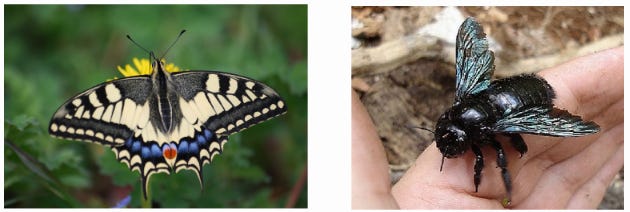
The miniature versions of the carpenter bee appeared to be perfect, but were about 50-66% smaller than normal. Since that summer Ms. Kordas has not observed any swallowtails or carpenter bees on the island. Kordas also speculates that the same miniaturization phenomenon is happening to humans, with babies born increasingly small in her neighborhood. This is anecdotal, however I have also noticed that newer North American generations of men and women tend to be shorter and smaller, with thinner wrists and diminutive foreheads. While a processed diet and malnutrition can certainly affect bone structure, chronic stress from EMF can disrupt normal levels of human growth hormone by persistently raising cortisol.
Crop Failures and Low Yields
We don’t need a Ph.D. in biology to understand that without the bees, there is no pollination, no food, and starvation. Robotic bees will not solve the problem, they will add to the catastrophe of radiation already silently unfolding.
Kordas has found:
“Everyone, including us, had problems with pollination this year, and crop yields were way, way down. Normally our summer beds produce a lot more eggplants, peppers, tomatoes and melons than we can possibly eat; we give some away and freeze large quantities for winter. This year we barely produced enough for ourselves, despite having extended the beds and put in far more plants than usual. I planted and replanted tomatoes of five varieties, over 60 plants in all. We barely produced enough tomatoes to have a few salads, for many plants yielded no more than one or two tomatoes. The problem wasn’t the plants, which produced scores of blossoms. The tomato blossoms were not being pollinated.
Home is where the hive is
While there may not be any Superman coming to save us or the bees from extinction - there is a man who has been coming to the rescue of our fuzzy little friends. In 2016, Derek Condit embarked on an innovative and pioneering endeavor known as the Shungite Beehive Project, merging his extensive knowledge of treatment-free beekeeping with the distinctive energetic properties of shungite. Once Derek integrated shungite into the structure of the hive, he has not had any instances of colony collapse. Here are one of Derek’s hives:
Shungite is a rare carbon-based mineral known for its high conductivity and unique molecular structure, and has long been studied for its ability to interact with various energy fields. By incorporating Shungite strategically within the hive environment, a protective energetic barrier is created that helps reduce electromagnetic stress and harmonize an otherwise toxic environment. Shungite also contains carbon 60, a biocompatible molecule that resonates in form and function with the hexagonal structure of the hive. I’m always leery when I hear the words “harmonize” in the world of EMF protection, but in the case of shungite, nature approves. In our upcoming podcast with Derek, he’ll discuss how and why bees don’t shun it.


Derek also recently started The National Beekeeper Emergency Response Network, a nonprofit organization that is mobilizing first response citizens and beekeepers all over the world to deal with catastrophes like the recent tragic accident that occurred in Washington state. On May 30th, a semi-truck carrying over 300 beehives resulted in the loss and endangerment of an estimated 14 million honey bees. This event was devastating. Despite the well-meaning efforts of bystanders, there was no clear plan, no organized team ready to respond, and no centralized resource to call upon for help. By putting a national framework in place, many of these emergency situations may be prevented.
The rest of our podcast with Derek will be released this Friday, June 20th! Here’s a snippet of our buzzing conversation:
Each of us can do our part to help save the bees, with no red cape required. All we need to do is don a beekeeper’s outfit, or be willing to donate some of our green honey money.
You can help support the National Beekeeper Emergency Response Network here:
Time to make honey
Ancient kings and queens of renown have been buried with jars of honey which have been found unspoiled. Honey was believed to sustain souls in the afterlife, symbolizing purity, prosperity, and immortality. Our ancestors relied on honey to treat wounds, burns, and digestive ailments. It was commonly applied to wounds to protect against infection and promote healing. Beyond medicine, honey appeared in Egyptian art, religious offerings, and even as currency in trade exchanges, demonstrating its multifaceted value. Since honey stores forever and its value remains relatively stable, beekeepers in Sweden even proposed it as a currency in the 1980s.
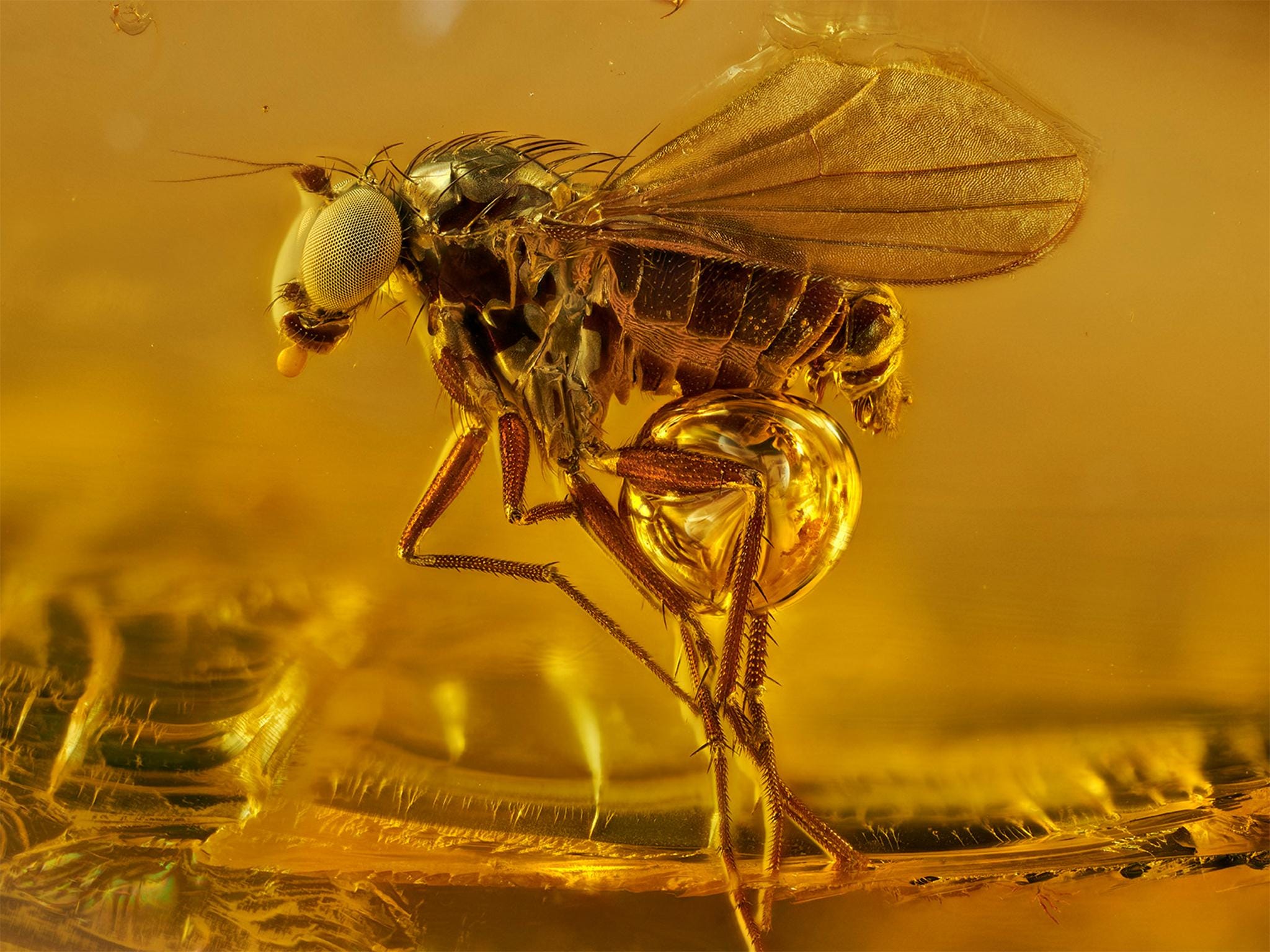
As the Greeks discovered thousands of years ago with amber, even a small electrical force can have a profound effect. Each of us may be just an electron in a cosmic ocean of energy, yet the same cosmic energy is within each electron.
Our present moment in time rises to meet us, and shape how history will look upon us. Most of the amber we see today is millions of years old, and originates from the resin of trees - a protective mechanism that serves to protect them from injury and pests. Time has commemorated much of life’s history in this miraculous substance, signifying the resilience of an immortal earth.
Even though our soul’s cortex may be bruised, let us seal not our fate, but encapsulate our destiny in a present time that even the gods can admire.
No bee makes honey alone.
We are more powerful than we know,
Roman & Bohdanna
Additional Resources:
June 20th. Join the World. Cancel your cell phone plan
To commemorate the initiative of Arthur Firstenberg, our colleagues around the world have decided to re-launch “World Cancel Your Cell Phone Account” Day.
Does this mean you have to throw out your cell phone? No, but preferable.
Consider sharing one phone with your partner, or as a family!
Cancelling your cellular account is a huge first step in dissolving the shackles of the digital gulag, and rebuilding the human hive.
Check out The Power Couple Bookshop - dedicated to helping us relearn from our ancestors!

Support us the old fashioned way!
Send us an email to info@thepowercouple.ca if you’d like to send us other forms of payment, including 🐌 mail.
Or…you can donate to our upcoming EMF projects here:
https://www.cellphonetaskforce.org/wp-content/uploads/2020/05/The-Honey-Bees-Plea.pdf
https://cellphonetaskforce.org/submission-to-fish-and-wildlife-service-on-the-american-bumble-bee/
https://jackkruse.com/ubiquitination-25-uv-light-and-poop-plants/
El-Gammal Z, Nasr MA, Elmehrath AO, Salah RA, Saad SM, El-Badri N. Regulation of mitochondrial temperature in health and disease. Pflugers Arch. 2022 Oct;474(10):1043-1051. doi: 10.1007/s00424-022-02719-2. Epub 2022 Jul 2. PMID: 35780250; PMCID: PMC9492600.
Sharma, Ved Parkash and Neelima R. Kumar. 2010. “Changes in Honeybee Behaviour and Biology under the Influence of Cellphone Radiations.” Current Science 98(10): 1376-78.
Cellular Phone Task Force: https://cellphonetaskforce.org/?s=honey+bees
Favre, D. Mobile phone-induced honeybee worker piping. Apidologie 42, 270–279 (2011).
Walker and Bitterman 1989a.
Hallmann CA, Sorg M, Jongejans E, Siepel H, Hofland N, Schwan H, et al. (2017) More than 75 percent decline over 27 years in total flying insect biomass in protected areas. PLoS ONE 12(10): e0185809. https://doi.org/10.1371/journal.pone.0185809
Panagopoulos et al, 2007, “Cell death induced by GSM 900-MHz and DCS 1800-MHz mobile telephony radiation”
So, I also see almost NO BEES up here in Upper Mitten of Michigan, however, we don't have a lot of 5G towers or even Cell towers. Then I visit my sister in Ann Arbor, and her garden is crawling with BEES! Ann Arbor is filled with Cell and 5G towers, smart meters etc....why are the Bees there doing well, and the ones up here in Rural Michigan are none existent!? I think a part of the problem is PESTICIDES. This area is farming. I found IOWA to be the same, when we drove through it,....not an insect was seen. Not a butterfly, not a bee, not even a BIRD! And all IOWA is is miles and miles and miles of GMO CORN. I'm sure the 5G is terrible for everything. I've seen the Trees that live near them die too. Birds will not nest near them!
But there is a lot more going on,...the Aluminum being sprayed down on us through Chem Trails is giving the BEES the same thing it gives humans, DEMENTIA. They can not navigate because of the toxic load of nano aluminum they carry. Toxic SPRAYING is being done around the planet too,....so someone or something is trying desperately to CULL all LIFE on this PLanet. The question is WHO? Even the Global Mafias have to have a Planet with life on it!
RFK Jr. said it was not HHS spraying us every day, he thought it was DARPA. But why? It's not for global warming, that's a SCAM. Why try to block out the sun while pushing solar panels!? Makes no sense. Something else is going on here.....and I cannot figure out what it is. The only thing I can think of sounds silly,....now that we know congress knows there are aliens, maybe they benefit from culling life on Earth? Sounds dumb. I know. But if everything else makes no sense, it's really all that's Left!
Mesquite honey, from the native mesquite trees that cover millions of acres of wilderness here, is one of the most famous products from the region where I live. "Colony collapse disorder" has never been a problem here with the local beekeepers, perhaps because of the remote nature of the area and the dearth of cell towers here. When the mesquite trees flower in the spring the honey begins to flow. When the honey flows, the bees swarm. While outside working in the spring, I typically see or hear several dozen swarms flying over my farm. However, because of severe drought conditions this year, I've counted only 3 swarms.
Any idea of how much Star Link effects bees Roman?