


Here’s what we’ll learn in this article:
1. Why light is more important than food for our metabolism
2. Why is India quickly becoming the most obese nation?
3. How obesity begins in the eye
4. How does our retina set our metabolism?
5.Why carrots won’t help our eyes
6. How does UV light lower inflammation?
7. How are our hormones are affected by light?
8. Why are sunglasses a bad idea?
9. The 2017 video lecture by Jack Kruse that “opened my eyes”
Yea, though I walk through the valley of the shadow of death, I will fear no evil: for thou art with me; thy rod and thy staff they comfort me.
~ Psalm 23:4
Why can’t some people stop themselves from eating too much?
Is it because they’re “bad” people who lack discipline?
Or could it be that their bodies are losing energy faster than can be replaced?
When stars lose energy, they expand and become a Red Giant.
When your ankle gets sprained, it slows down and becomes inflamed.
Why would our metabolism be any different?
Looking at history, unless you were King Henry VIII, you probably weren’t obese.
Why is India now on track to be the second most obese nation by 2050, a land whose populace was mostly thin?
The prevalence of obesity in India has risen by 155 percent in men and 104 percent in women since 1990.
The current obesity epidemic in India is being blamed on people not knowing what food they should eat, and eating too many carbs. Yet history teaches us another lesson. India maintains a rich, holistic culinary tradition, balanced with the principles of Ayurveda. Why aren’t the people of India no longer able to process a diet previously rich in carbohydrates?
Other than the arrival of processed food, what else changed?
As early as 1986, call centers began cropping up in India. In the 1990s, companies like Dell, IBM, and General Electric set up their operations to the country.1 Bangalore is known as the epi-center of the Indian Silicon Valley, and happens to also be the area where obesity is rampant2:


India is a canary in the coalmine of the electrosmog we’re all trying to fly through as a species. Our light environment experienced a massive shift in the 1800s, as we began to spend most of our time indoors like King Henry, in the modern day medieval castles of the office space, and plush couches dripping our vitality away faster than a soft serve ice cream cone in Mumbai.
Have we advanced from a Temple of Doom, only to recede into a Palace of Gloom?

Let food be thy light medicine
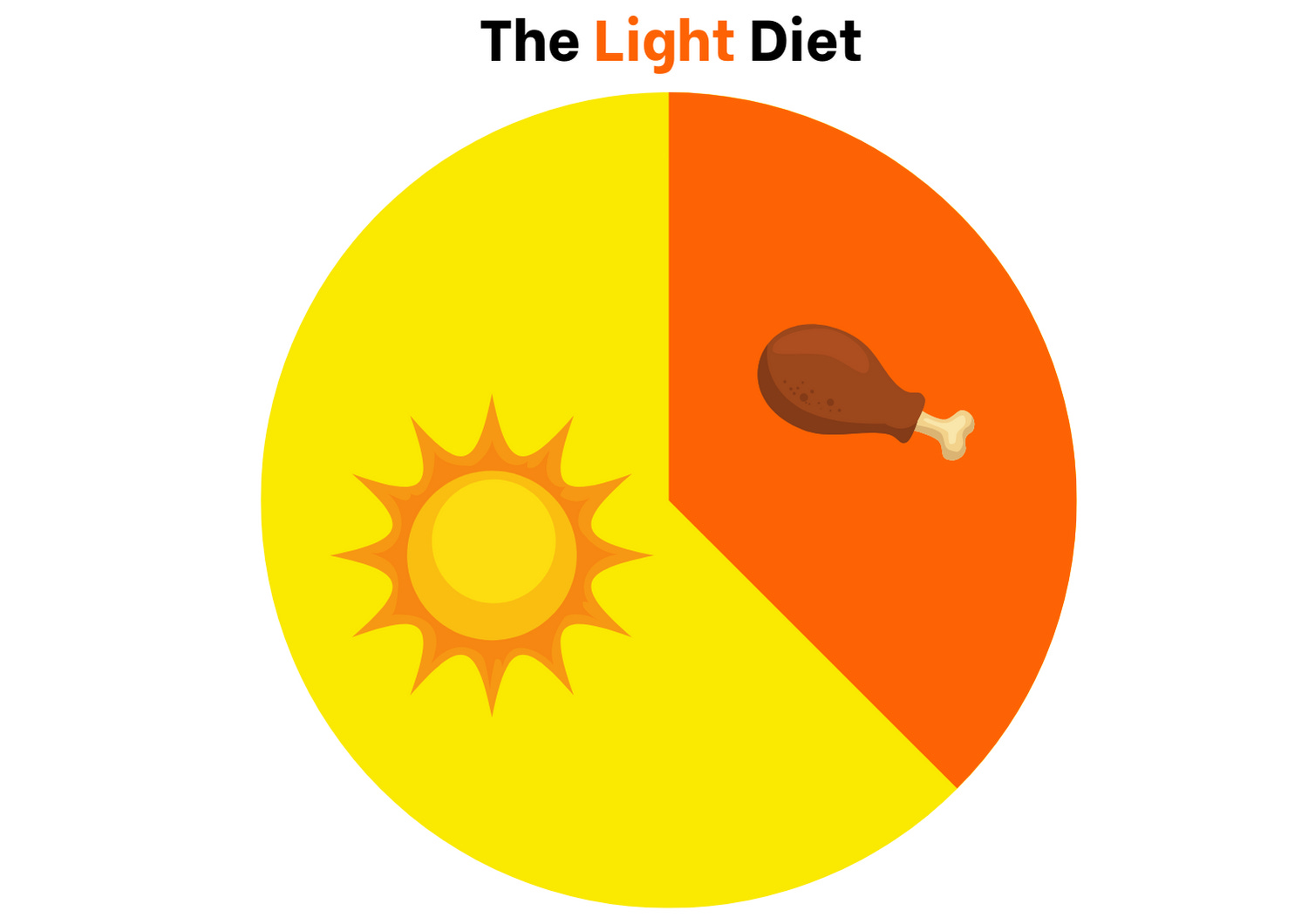
We recently interviewed photobiologist Alexander Wunsch, M.D., who maintains that an astounding two-thirds of our bodies’ energy requirements come from the light our bodies absorb, while only one-third of our energy is acquired through the food we eat. That means pounding back potato chips outside could very well be healthier than nervously nibbling on kale as you respond to email.
How can we take back our bodies, so that we can fight like the knights of the round table, instead of looking like a round table?
Let’s meet at the starting gate of all diets - our retina.
Our eyes aren’t a camera, they’re a clock
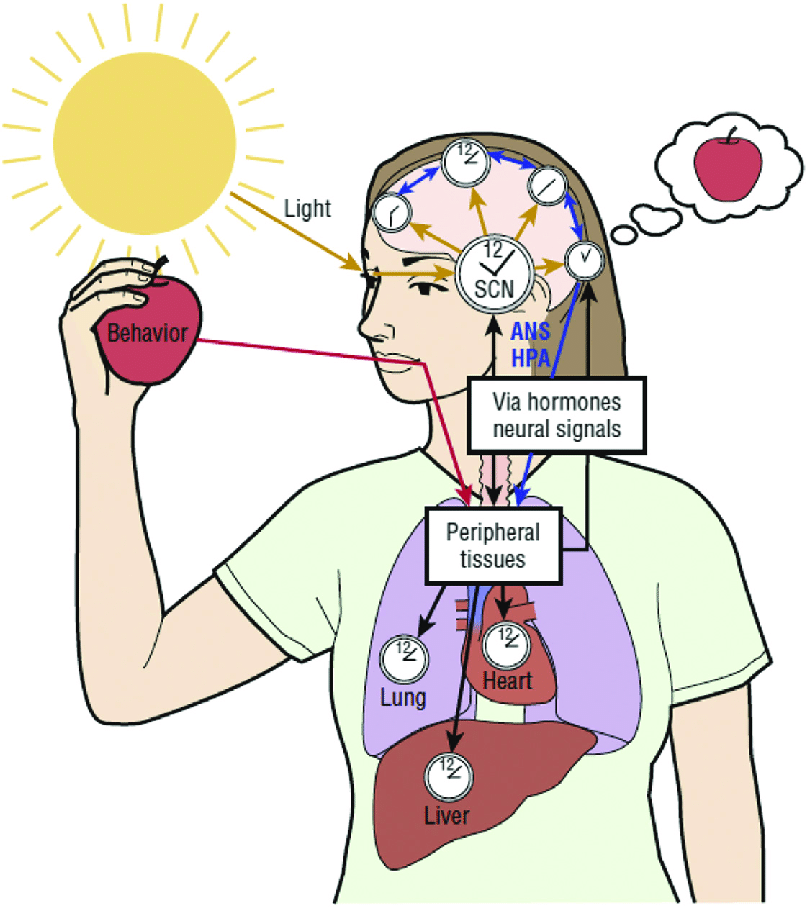
Our bodies function according to a circadian rhythm, which is governed by a master clock, known as the supraciasmatic nucleus (SCN)3, located in the hypothalamus of our brain.
The retina is the only part of our bodies that can bypass this master clock.
We have photoreceptors4 in our eyes that can set their own internal circadian rhythm by directly synchronizing to light without input from the brain.
What does this have to do with obesity?
When these photoreceptors are damaged by being exposed to harmful amounts of blue light, our metabolism is directly affected.
As I’ll explain in this article, these photoreceptors bind with retinol, a form of Vitamin A. When this bond is broken, Vitamin A becomes a wrecking ball in our metabolism, not allowing certain hormones such as leptin to work.
Leptin gives us the feeling of being satiated from a meal.
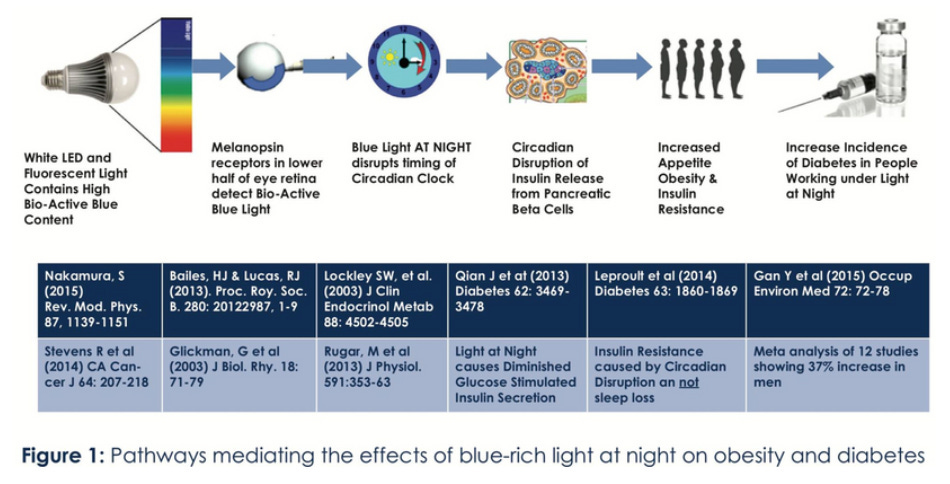
Let’s break down this process, which starts with light hitting our…
Opsins - the unsung heroes
Many of us have heard of rods and cones, which process visual images for our brains to “see”. However, our eyes contain other photoreceptors that do not see anything at all - they keep time.
These photoreceptors are melanopsin and neuropsin.
Melanopsin processes the light around us as a non-visual signal, or timestamp, and sends this to our SCN. This in turn regulates our circadian rhythm – which dictates when we wake up, feel alert, hungry, and tired.
“For many years people viewed the eye as if it were an old-style camera, without a light meter. The discovery of the first non-visual opsin, melanopsin (1998), identified the first light meter in the eye. “
Ethan Buhr, Research Professor, Johns Hopkins & Cincinatti Children’s Hospital
Neuropsin is another type of photoreceptor that was only discovered recently (2009) to operate independently of the SCN.
A University of Washington study confirmed that when rod, cone, and melanopsin cells were removed from mice, their circadian rhythms continued, however researchers were surprised that their retinas were still responsive to light changes due to the presence of neuropsin.1
When neuropsin was removed, the mice lost all ability to adapt to changing patterns of light and dark.
Why is this important?
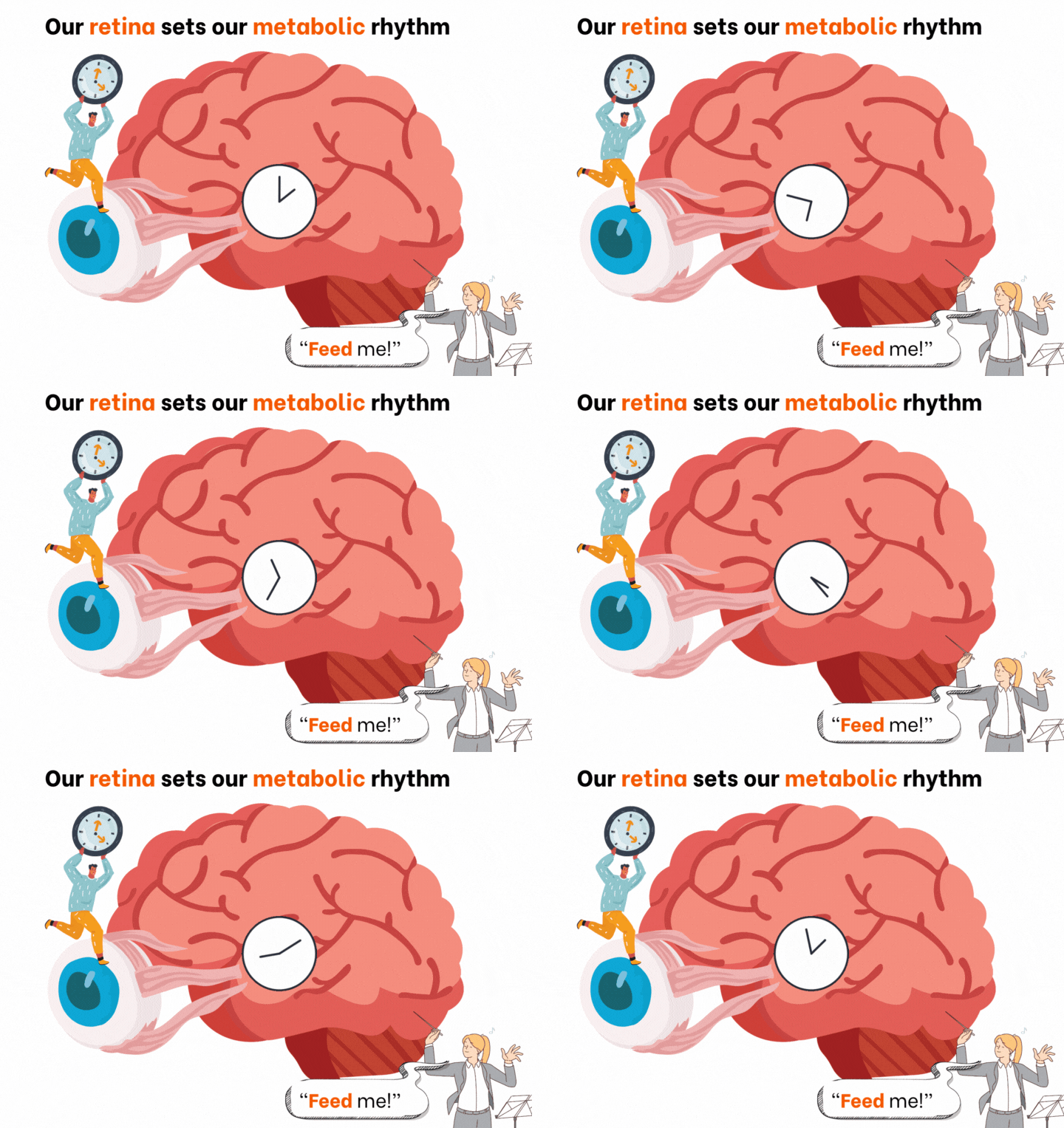
Our metabolism, along with the hormones and genes that our bodies ultimately express are all based on these cycles of light and dark - our circadian rhythm.
When we lose our ability to track time, no amount of vitamins or supplements will help us.
This is why Bohdanna and I want to help so many people to improve their health. We used to listen to the food and diet gurus, and wound up like a broken, busted clock.
How can we ensure this doesn’t happen?

What drives the gears of our Divine timepiece?
Be the light, not the carrot.
All opsins bind to a form of vitamin A called retinol.
Get it…retina - ol?
Vitamin A in the form of retinol only comes from animal foods. We are often told that we can get a bioavailable form of Vitamin A from the beta carotene (a type of carotenoid) in vegetables like carrots.
This is partly true, however many of us are poor converters of beta carotene.
We can however convert the carotenoids from eggs, shellfish, salmon and liver, very easily to this active form of Vitamin A - retinol.
If you’ve read our article on how we can “eat our sunscreen,” you’ll understand that these types of carotenoids help us quell stress from our modern light environments, which are not only saturated with Wi-Fi, but also blue light.
When our skin or eye becomes overrun with blue light toxicity, our conversion of carotenoids to an active form of Vitamin A (retinol) is ruined, and this causes circadian rhythms to be disrupted.
When blue light from morning sunlight first enters our eyes, Vitamin A within the brain transforms the light signal to tell our bodies it’s daytime.
The opsins in our eyes have a very loose bond to retinol. Retinol controls the neural signaling along the central retinohypothalamic tract (below).
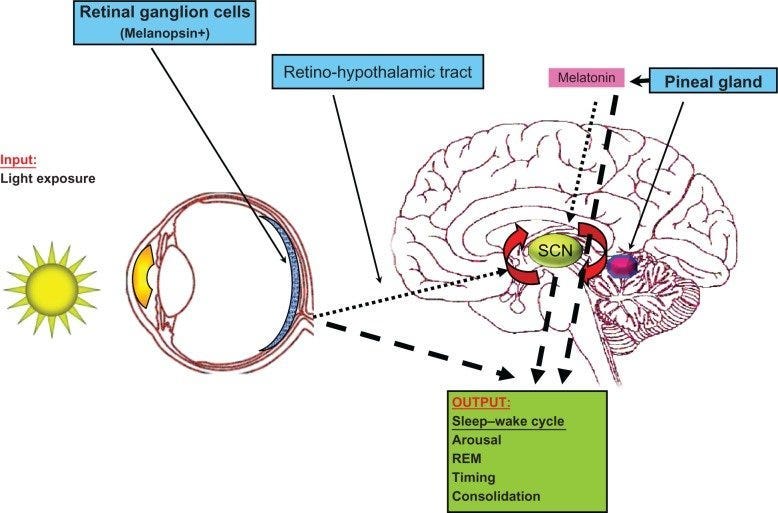
This tract connects the retina to the SCN, and also connects to the leptin receptor in the hypothalamus. Remember: our leptin hormone lets us know when we are full after a meal. It’s the fuel gauge on our car that tells us how much gas we have before we start running on empty.
What happens when the bond between retinol and our opsins is broken?
Retinol is liberated in our system. While this may sound like a good thing, free retinol actually creates chaos in our bodies as it’s meant to be coupled with our photoreceptors during the waltz of our metabolism.
Free radicals like this constantly seek to bind with another atom or molecule to become stable. Electrons need to be paired to be stable. What ensues is a chain reaction of electrons being paired to the wrong molecules.
When we have too many electrons flowing too quickly in our bodies, our metabolism breaks down.
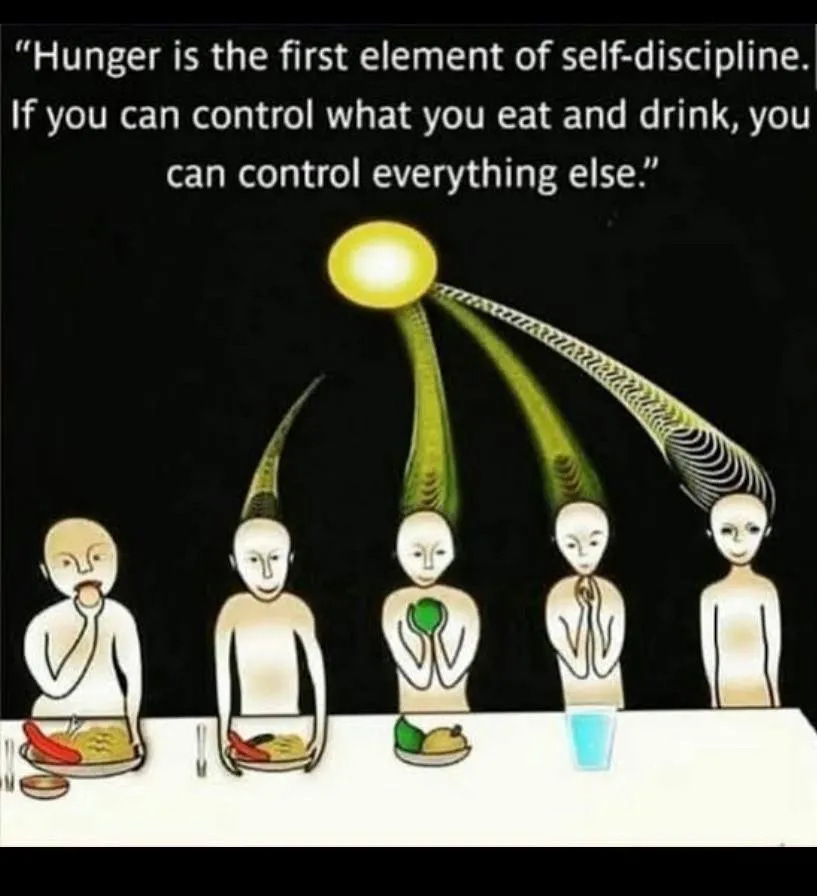
This is why eating less leads to longevity. A slower metabolism means less stress on our system.
Yet how many times have we heard from the food gurus that we should eat six times per day so that we can “speed up” our metabolism?
The mitochondria get a D
As retinol (Vitamin A) gets liberated, this lowers Vitamin D as a result.
UV light creates Vitamin D, which binds to our mitochondria, the engines of our cells, which regulate our metabolism by slowing electron chain flow. When electron flow in our bodies is slowed down, we tend to eat less food as our metabolism runs more efficiently.
Our entire metabolism runs on what is called the electron transport chain. When we’re exposed to harmful amounts of EMF or blue light, the last link in the chain is broken and digestion breaks down.
Light from the sun also stimulates melanin, which helps give our metabolism a boost. For example α-melanocyte-stimulating hormone (α-MSH) has been shown to induce weight loss in animals, but its absence can lead to less melanin, which ultimately leads to disease.
How does this happen?
You down with POMC, ya you (don’t) know me.
Proopiomelanocortin (POMC) is a prohormone, which makes other hormones. Hormones tell our bodies what to do. POMC is part of the melanocortin system that makes MSH. Much of what is known about our brain’s control of overall energy balance and fat storage stem from what we know about the melanocortin system and leptin. Ultimately, POMC helps us maintain blood sugar levels, protects the body from stress, and suppresses inflammation using MSH.
How can we make more POMC?
Like Vitamin D, POMC is made when we expose ourselves to UV-B light from the Sun. To make sure we don’t get burned with UV, we need to get outside in the morning, before UV is present, so that we can absorb infrared light. The more we “pre-heat” our skin with infrared, the more we can cook until golden.
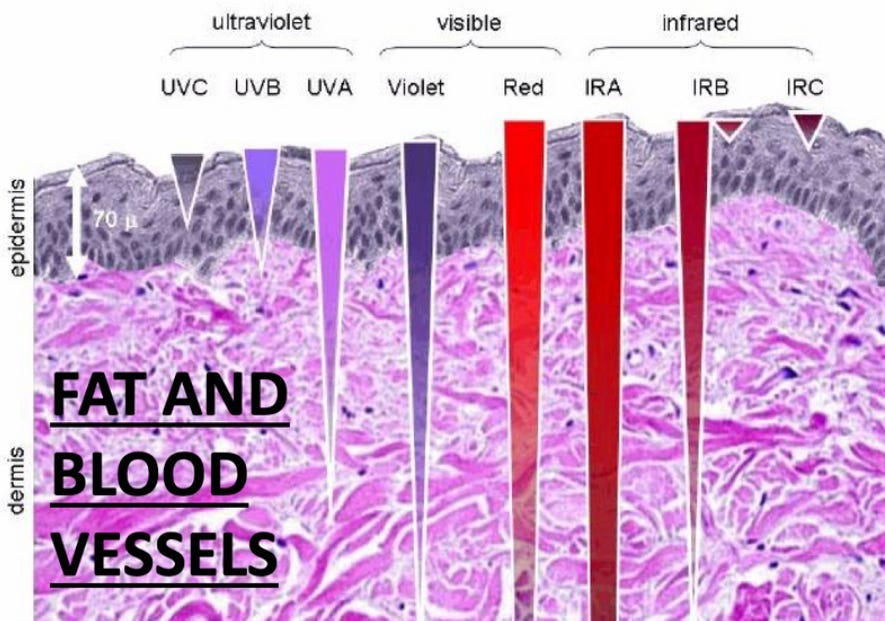
Why is this important?
If we consistently expose ourselves to LEDs, fluorescent lighting, cell phone and TV screens without proper eye protection, we won’t make POMC very well.
This can cause a lack of mitosis, which means our cells can’t divide correctly, leading to obesity and cancer.3
POMC is ultimately regulated by leptin. However, when our opsins are destroyed and retinol becomes a liberated wrecking ball, our leptin levels also fall, along with dopamine, melanin, and melatonin.
This is why many often feel sick very quickly in sunlight - the process of mitosis and melanin (MSH) generation has been affected. Our eyes produce MSH when exposed to UV, and MSH helps lower inflammation. That’s why wearing sunglasses makes one more prone to sunburn, as the eyes no longer get the UV signal to lower inflammation:
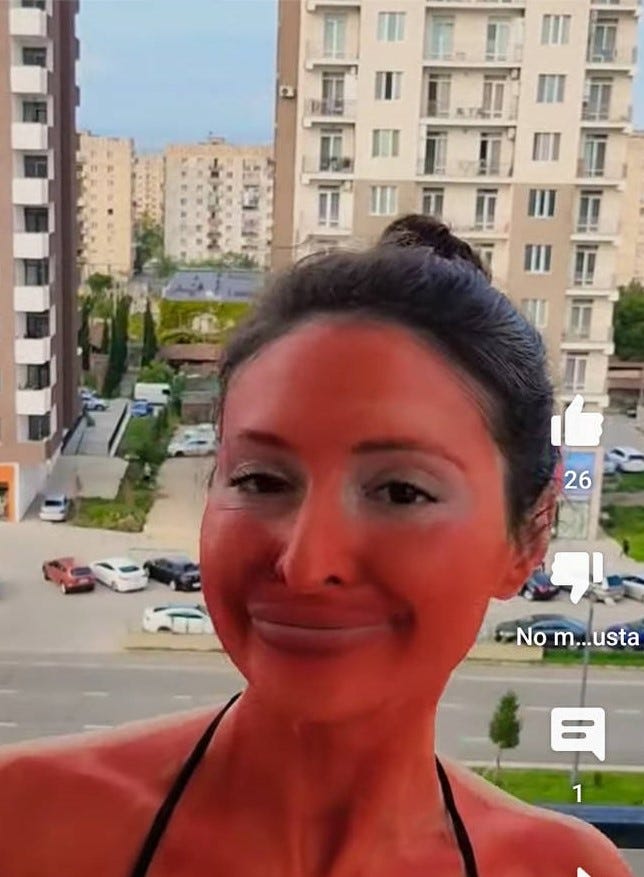
I still remember the days of slathering on tons of oil on the beach, but I never really enjoyed wearing sunglasses, mostly because I lost them all the time. What I loved more than looking good on the Jersey shore, was feeling good. I was never really hungry, and felt like I could play like a child all day, without the need for candy. Now I understand that this was UV light putting POMC to work - reducing my appetite with increased levels of MSH.
In my twenties, when I’d party all night, I’d wake up in the morning to grab a butter-soaked pistachio muffin from one of the streetcart vendors slugging it out on the baked sidewalk, and then go running for miles on the boardwalk. The only other meal I’d eat was dinner, and then beer for dessert, which didn’t technically count because I was back then…who’s counting?
In my forties today my version of a crazy night is eating popcorn while reading War & Peace. Even though the next forty years will be spent reversing the mistakes of the first forty, I’m still grateful I had all that sun exposure, and even more grateful for leaders in health like Jack Kruse who are confirming what my primal instincts always suspected.
I hope we can all crawl out of our call centers, and embrace the call of the wild - whether it’s the Jersey shore or the bore of our backyard. As we walk through the silicon valley shadow of death, let us fear no evil. Let us use the rod of our eye to ward of the darkness, the staff of our soul to light the way.
We are more powerful than you know.
Roman & Bohdanna
Additional Resources:
Many of the insights from this article were inspired by Jack Kruse :
Check out The Power Couple Bookshop - dedicated to making us relearn from our ancestors!

Support us the old fashioned way!
Send us an email to info@thepowercouple.ca if you’d like to send us other forms of payment, including 🐌 mail:
Roman Shapoval
PO Box 1198
Fonthill ON
L0S 1E0
Canada
https://www.linkedin.com/pulse/outsourcing-pioneer-how-india-became-worlds-first-country-juan-martin/
Kundu, Sampurna & Sharma, Pratima & Singh, Shivani & Kumar, Pradeep. (2023). District-level heterogeneity in overweight or obesity among women of reproductive age: A geo-spatial analysis in India. PLOS ONE. 18. e0290020. 10.1371/journal.pone.0290020.
https://romanshapoval.substack.com/i/107636609/our-master-clock-the-suprachiasmatic-nucleus-scn
https://romanshapoval.substack.com/i/107636609/our-blue-light-detectors-melanopsins
Lots of useful information. Slow metabolism is indeed a prerequisite for longevity. Mercola campaigning for speeding it up only shows he has been captured. Even exercising can accelerate the absorption of synthetic proteins from injections…
thanks Roman - great article! and an excellent unpack of the science, in laymen's terms with words defined.
spot on re sili valley "the shadow of death"
part of the problem with the call centers in India is that, because of the 9 to 13 hour time difference between India and most western nations; they end up working at night (under blue light) and sleeping during the sunniest hours, thus destroying their circadian rhythms in two primary ways.
whenever i float the idea that it's not the food; it's the light environment, most people think it's absurd - especially the food "gurus" who think the acceleration of diabetes and obesity is just due to too much sugar (actually in the 1950s and 60s there was plenty of sugar in most diets, and fat people were rare. even one fat kid in a class of 30 was unusual)- now we have to act like it's normal to be morbidly obese at the risk of being politically incorrect.
i also thought jack kruse's 2017 nourish vermont presentation was, perhaps his best and most comprehensive.