

I stayed in a Smart Hotel: here's what I learned 👉
Fire & Security Risks | Digital Nomads Beware EMF

Here’s what we’ll learn in this article:
1. How biometrics can be hacked
2. Wi-Fi modems and lax hotel passwords
3. How I had to rely on people to help me
4. How I mitigated EMF in the smart hotel
5. What are smart noise sensors?
6. How I changed the light environment of my room
In the days of Olde, herdsmen who wandered the countryside in search of greener pastures were called nomads. Today shepherds of the Western world have transformed into digital nomads, seeking places of refuge from the 9-5 animal farm. Yet an invisible wolf stalks them all the while. The predator trails them like a shadow to virgin lands, devouring communities from the inside out with fangs of unabated electrosmog, disemboweling the security of society with the not-so-smart technology that supports a digital lifestyle.
Recently I stayed at an Airbnb in Phoenix. I was representing the Weston A. Price Foundation at a conference, and a member (we’ll call her Jessica) of the Foundation had booked a hotel for me. The first question I asked Jessica was: “what’s the address?” What I thought was a straightforward question was not so simple. It turned out that in order to access the room details, I would need to submit a selfie to “verify” my identity.
In order to skirt this process, I then asked “who’s the host?” I thought I would be able to get in touch with them and show my ID another way (e.g. providing my birthday). It turned out that there was no human host, but a corporation called Cozy Suites with a chatbot that I’d need to go through. Cozy Suites is a separate entity that leases select rooms in other condos and high rises. I held firmly with the chatbot that I would not submit a selfie, stating that I had no access to a camera. Needless to say, the AI chatbot did not compromise, empathize, or understand my side of the story.
I expressed my concern to Jessica, and asked her if she’d book a “normal” hotel room. She could not do so, but wound up submitting her own selfie for me, and managed to still be able to add my name to the reservation. Even though I’m grateful to her, I did not ask her to do this, and would not want anyone to need to be a straw man for me just to compromise their own identity. If you’ve ever watched Minority Report, it’s not hard to imagine the future: a black market anti-AI industry using 3D genetic printers to create identical eyeballs to mask someone’s true identity as they travel the digital highway.
How biometrics can be hacked
Unfortunately, hackers are already employing what are called injection attacks, where they can write code and fabricate someone else’s identity using data from AI. By leveraging camera emulators and specialized software, hackers simulate live streams, bypassing the need for a physical camera or presence. Jumio, the company contracted by Airbnb to facilitate its biometric application, recently warned:
“Instead of presenting an image or video in front of the camera, injection attackers alter the system at its source, compromising the integrity of the digital process. Their effectiveness can result in financial fraud, creation of fake identities, evasion of regulatory controls, and loss of user trust.” - Source
I should also mention that I do not have a cellular phone plan, but I do carry an iPhone when I travel. I cannot call or text from the phone using a traditional carrier like Verizon or AT&T, but I use Zoom instead. I can only use the phone when connected to Wi-Fi or when I hard wire it to the internet. I refuse to pay for “a plan” for my own enslavement and irradiate myself anymore than I have to. Yes, Wi-Fi is radiation, but is fairly localized and still optimal over having multiple cell towers triangulate and beam form upon your position.
The era of “smart” travel sites like Airbnb promote the instant gratification economy, as the software assumes users always have their phones on them, and can check in and out on their travels, at the very last minute. Personally, I like to plan ahead. I like to know where I am going, where I’m parking, and who I’m meeting upon arrival. Traditional hotel rooms let you do just that. You actually get a physical address, so that you can write / print out directions before hand. Some even give you an actual key, which you control, and whose code can’t be leaked over the internet. Imagine that! That’s so 2018 of me to say.


Unfortunately, Jessica had booked the hotel for me so late that I did not have a room code until I arrived at the convention center in Phoenix, accessing my email over public Wi-Fi to retrieve my hotel credentials. As I pulled into the hotel parking lot, I was greeted by a friendly valet. Bad turned to worse as my code to get into the building didn’t work, and the screenshot I had taken of my hotel’s Wi-Fi code was cut off. Whoops.
Other than the valet, who worked for a separate company, there was no concierge to greet me, and no way for me to access my credentials or Wi-Fi unless I could get onto a public Wi-Fi network somewhere in the city. There was no telling when my room code would become activated. There was one concierge at the hotel, who I thought could help me. Unfortunately, he had nothing to do with Cozy Suites, and he only worked for the condominium. I’ll never forget the inhuman, nonchalant way he said “I can’t help you” as he put his head back down into his phone. This was the non-loving nature of the AI beast in full display.
👉 Become a premium subscriber.
Unlock discounts on 1:1 EMF coaching & services.
(just $5 per month).
Cozy Suites even proudly brags on their site that “booking is quick, easy, and fully online—no front desk required.” I have booked hotel rooms over the phone in minutes, and still use booking.com which eventually gives you a front desk when you get to your place. Next they’ll be selling you the right to drive through another company, without owning your car keys, or your car. Fingerprints and genetic material from your firstborn first of course.
It’s 10pm. Do you know where you Wi-Fi modems are?
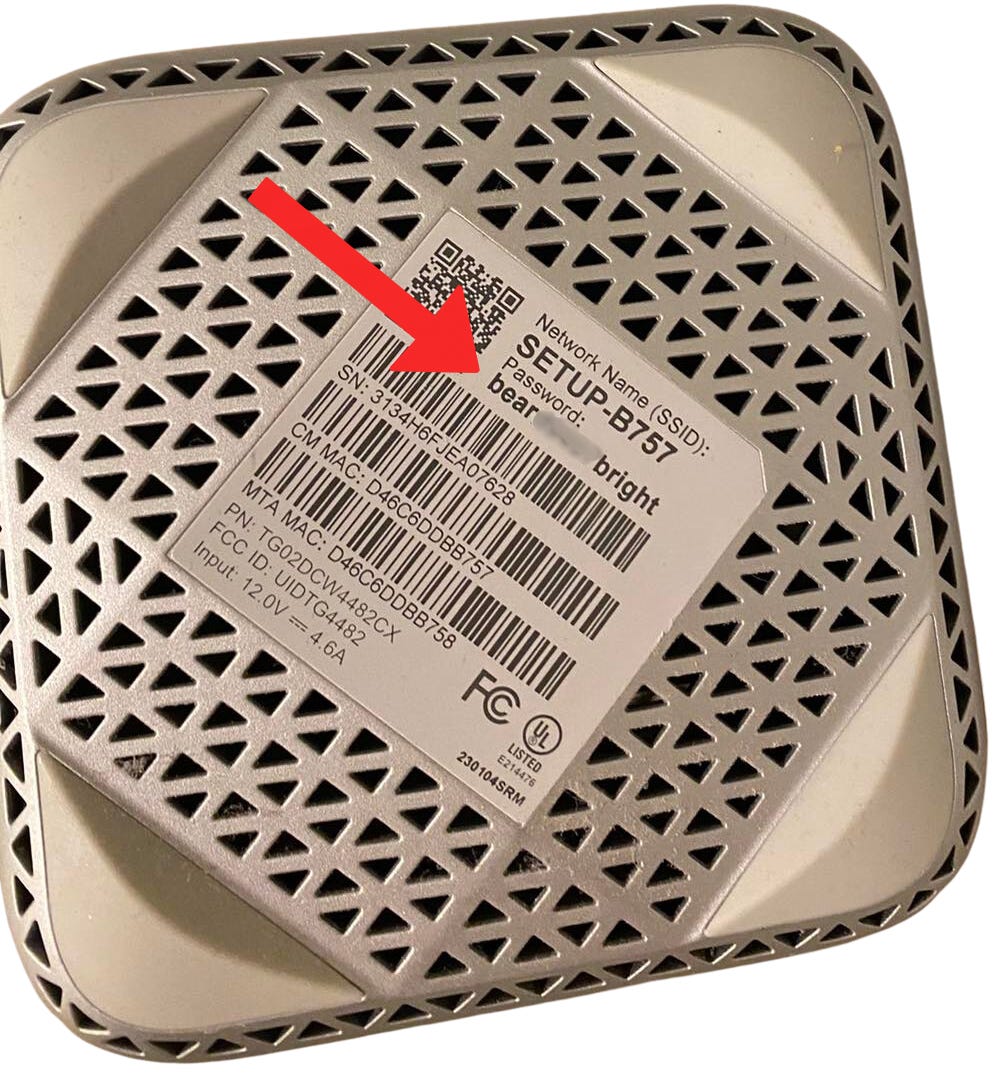
I was now left with the prospect of potentially sleeping outside of the hotel, as my code wasn’t working, and I had no way of contacting Jessica. I wasn’t going to let that happen, but it was a reality. Thankfully, the kind valet let me use his phone to call her, and she was able to eventually help. As I finally opened the door to my hotel room, I was left with one issue: not being able to access Wi-Fi, which would be my main mode of communication the next few days. Jessica had not sent this info unfortunately. I humbly went back down to the parking garage, and asked the valet if he could help in any way. A condo resident named Jeff overheard my conversation, and sprang to my aid. He told me to check the bottom of the Wi-Fi modem, as typically it includes the password with its model number. He doubted that staff changed the code, even though it’s standard protocol to do so. Luckily he was right. I put in the code, and I was now free to roam digital pastures - aka call my wife to let her know I was okay.
The Good Samaritan of Dystopia
One profound benefit to traveling with less technology is the trust that one builds in fellow human beings. I’ll admit, I used to let my pride get in the way of asking help from a stranger. Now I relish in 1:1 interactions, using them as a testament to humanity. These common decencies are the thin veil of society that needs mending, and quickly. If it wasn’t for the kind valet, or Jeff the resident, I would have had a later night, and lost more time. But my potential loss turned into a gain of trust in my fellow man.
The Parable of the Good Samaritan, found in Luke 10:25-37, tells the story of a traveler who is attacked and left for dead. While a priest and a Levite pass by without helping, a Samaritan, stops to care for the injured man, demonstrating that true compassion transcends social and cultural boundaries. The help I received were from men of different religions and worldviews, even in the midst of a global deification of AI.
Was I left for dead? No. But many of us may be if the biometric social credit system takes hold. How we’ll respond will determine our collective fate, and the trajectory of humanity. The ultimate, and only way any one of us can “reach out and touch somebody” is through our heart.
How I mitigated EMF in the not-so-smart hotel
Now I’ll describe the next steps I took to mitigate the not-so-smart, and not-so-healthy, technology scattered throughout my room. Upon entering, I always unplug the unnecessary. Why shield more devices, when less is more?
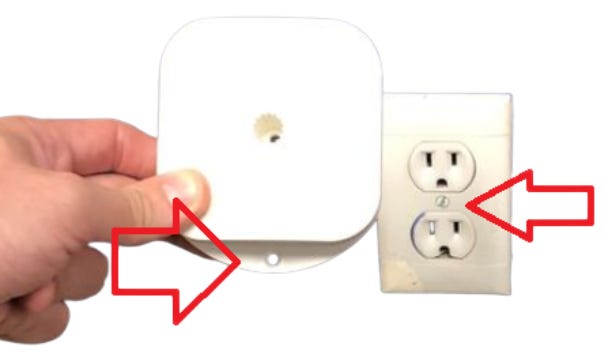
The first alien device I saw was a flickering white box plugged in, and screwed into the plate of the electrical outlet. Butter knife in hand, I unscrewed it, just so I could unplug it from the wall. Luckily I was able to turn the power off at the circuit breaker, located in the bedroom, before unscrewing the bugger. Upon further research, I found out that this was a noise detector.
The eerie sound of silence
These sensors are equipped with acoustic microphones, processors, and connectivity (like 4G/5G) to alert the owner of house parties, but can also be used to spy on people and can even detect a whisper. These sensors are being rolled out throughout smart cities in an effort to keep noise pollution down, so that all that is heard is the sound of eerie electric vehicle engines. This technology could be a way to enforce talking or freedom of assembly when the next lockdown is proposed.
Will talking, like cursive writing, become a “barbaric” relic of the past? As we learned in 2020, tech companies often use health as another reason for more draconian measures. Noise detectors aim to work with the home’s energy system to create a “peaceful environment” and “enhance sleep”, turning the lights off, or adjusting the thermostat.1 Turning the temperature down can of course occur at any moment the system or owner determines it appropriate.
The ultimate irony to noise detection devices is the fact that they create more noise in the form of high-pitched frequencies, which can be heard by animals as well as those who have tinnitus. We know that humans can hear electromagnetic energy in the ultrasonic range from 20 Hz to about 225 kHz. Radiofrequency transmits at these levels, and also emits above 225 kHz.
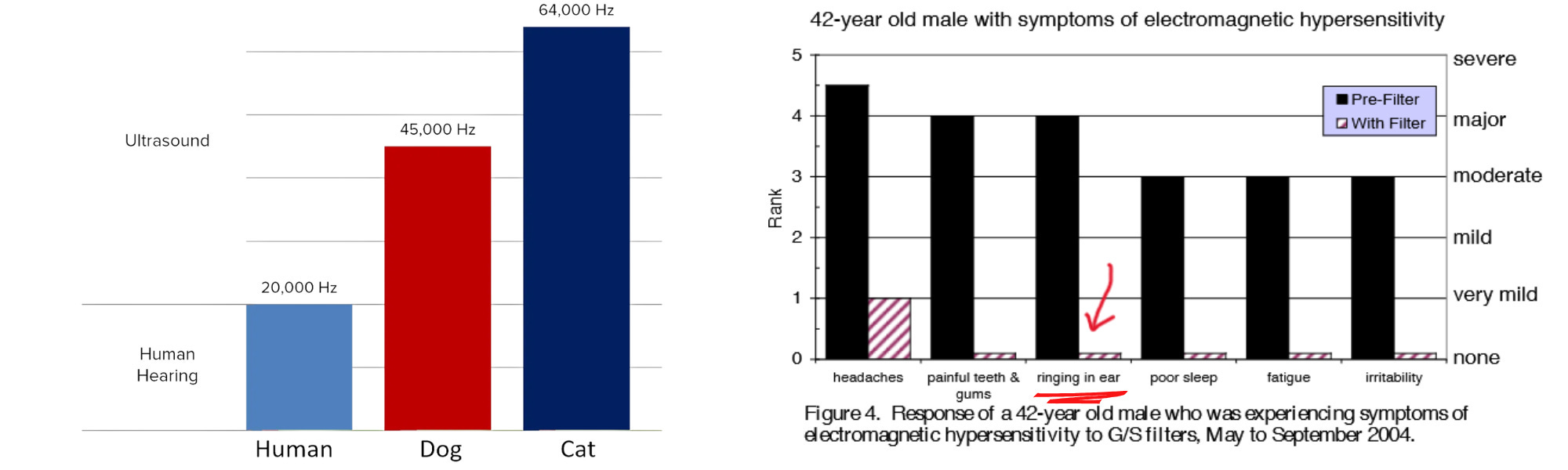
Dr. Magda Havas and Dave Stetzer studied the effect of kHz frequencies on tinnitus, and found that these individuals suffering from tinnitus had high levels of dirty electricity in their homes. Some participants noticed that when the buzzing sound was loud, the dirty electricity in their home was high. When Stetzerizer filters were installed, these sounds became less audible. Dogs can also hear in the range of 20 kHz, which is why there have even been accounts of animals not wanting to walk on certain parts of the street with smart tech infrastructure such as LED streetlights.2 Noise attenuators employ energy-efficient technology, which means they are more likely to create dirty electricity (DE).
I always bring Stetzerizer filters with me for this reason, along with a Stetzerizer meter to measure the amount of DE. When I first arrived at the hotel, levels of DE (measured in Graham-Stetzer units, GS) were 400 GS. After I unplugged everything else I could - the microwave, coffee maker, lamps, readings decreased to 300. After installing filters, I was able to get readings under 40 for most of the hotel room. While under 25 GS is ideal, I was still relieved that I could get the number down this much.
At night I was able to turn the power off to my bedroom, as well as unplug the Wi-Fi at the panel. I was able to boot up Wi-Fi with no issues again the next morning. All I needed to do was restart my computer so it could find the network again. I hear from many clients that one of the reasons they don’t turn the Wi-Fi off is for fear that it won’t work the next morning. Unless you have other apps like wireless security cameras running on Wi-Fi, you have nothing to fear. I advise people to do a test-run in the middle of the day, turning Wi-Fi off then on, to see what happens. What do you have to lose? Your sleep - if you don’t try.
Turning hotel Wi-Fi into hotel hardwire
In my EMF travel toolkit, I bring extra data cable just in case the room has an ethernet port. Many rooms often do, however most of the time the ports are inactive. The next thing I’ll be adding to my kit will be an ethernet extender. This will enable me to then unplug the Ethernet cord from the Wi-Fi modem, and use this same data connection to hard wire my laptop, etc. Heck - you could even set up your own LAN (local area network) with multiple devices if you have a router as well. This scenario all depends on whether the Wi-Fi modem is even accessible. Often its enclosed in a white box attached to the wall, in which case plan B kicks in: wrapping the modem with heavy duty tinfoil (you can ask the hotel kitchen for free foil if you’re nice - I tell them I’m trying to keep my food warm).
Below is the data access panel in my room. The yellow cord would get the Ethernet extender:


Night lights not day light monsters under the bed
Once the electrical EMFs are reduced as much as possible, I go to work on the light environment. I bring a piece of red auto lens repair tape with me to cover any bright lights I can’t turn off. Then I put in a clamp lamp typically used to incubate eggs and keep chickens warm as my main light, with rechargeable amber clip on lights throughout the room. Here’s an article with more info on some of those devices:

Whenever I travel, I also bring my Berkee water filter with me. I’d rather have to carry in this canister with me once, than have to lug bottled water like a mule. A colleague of mine at Relax Sauna, who had a booth right next to me at the conference, was gracious enough to let me borrow his far infrared lamp. I used the lamp to structure and create what Gerald Pollack calls The Fourth Phase of Water. Far infrared light, specifically at the frequency of 3000nm, builds the EZ (exclusion zone) of water, and creates more energetic potential in our cells by supporting the process of charge separation of positive and negative polarities in water. This type of EZ water can also support detoxification and be a buffer against electromagnetic stress.3


I found that the most dangerous aspect of staying in a smart building was security. Other than the valet, there was almost zero human personnel that could assist in an emergency. The main premise of the entire “smart” industry is built on convenience and safety, delivered to our door in a dash, by an artificially-omnipotent intelligence. The irony? Living in a smart home or hotel is neither convenient nor safe. One morning after I came back from my walk, I asked the valet on duty for my car keys. I pointed to the silver car, and said “yes that one.” He just handed me my keys. Humans, like bewildered dear no longer terrified of other human predators, have forgotten how to think critically and see red flags. Younger people especially make less eye contact, losing their primal sense of intuition. Don’t let this be you.
Think about the implications of having a hotel room code emailed to you and stored somewhere on the internet. If someone really wanted to, they could not only break into your place very easily, but may be able to lock you in remotely. The last night I stayed at the hotel my paranoid mind went to “what if there’s a fire, and I get locked in my room?” Hotel signage tells us to avoid the elevators in case of a fire and electronic malfunction, but keyless doors that automatically bolt themselves each time aren’t a hazard? I propped my door open with a shoe, and closed the door to my bedroom. If someone wants to rob me in the middle of the night - go ahead. Most people are too busy binge watching criminal junk on TV to actually have the balls to become one.
As we meander down the preciously-metallic path of electronic pastures, we should consider who and what is herding not the sheep, but the shepherd. We are deceived at each dark turn in the road, with a promise of a golden age that is really a Red Dawи. Trails of metals float in the sky, leading us to a slaughterhouse of self-destruction. Yet the clues to our demise point to a larger picture. The soiled sky above reflects the air we’ve polluted with radiofrequency from below. If we can reconstruct our homes, transform them from a prison into a shelter from the electromagnetic storm, blades of green grass may yet laugh again under all of the beasts of the Earth.

👉 P.S. Need help mitigating your EMF environment? Let’s chat!
*Paid subscribers get one free 1:1 consult.
If you found this article valuable, would consider sharing it?
Additional resources:

Check out The Power Couple Bookshop - dedicated to making us relearn from our ancestors!

Support us the old fashioned way!
Send us an email to info@thepowercouple.ca if you’d like to send us other forms of payment, including 🐌 mail!
https://help.noiseaware.io/hc/en-us/articles/360024451793-NoiseAware-Gen-3-Product-Specifications
https://www.cnet.com/home/smart-home/is-technology-driving-your-pet-insane/

I recently stayed at this type of hotel in Houston. It was a depressingly modern, brand new condo-complex. About half of the units were privately owned by individuals, the other half was corporate short-term rentals. I think one corporation had all of them in this building because you could see all of the connections from your WIFI menu. The technology was standardized. The TV’s were set up for streaming only. I was there working and had a book so didn’t bother with my TV.
Later in the evening after I had returned from dinner, I was reading on the sofa. My TV suddenly turned on of its own accord. Then I see porn streaming on the screen. Then it goes off and on intermittently. And finally, I see some random dude’s face on his selfy cam trying to figure out why his porn won’t stream to his TV. At this point, I started unplugging shit. LOL.
Smart is the new dumb! https://timothywiney.substack.com/p/literal-sheeple